


Looking Ahead to Survive: The 5 and 20 Rule to Avoid Real-Life Pitfalls
“It’s just a parking lot. It’s just a walk to the car. What could possibly happen?”
This is exactly the kind of thinking that turns a daily routine into a trap . The truth is that most attacks do not happen by chance, but because someone did not see the danger coming .
Not for lack of strength. But for lack of attention.
In this article I will reveal a simple but extremely effective technique to avoid becoming a victim:
the 5 and 20 second rule.
A method that trains your mind to perceive what others ignore, to anticipate before it’s too late, to walk down the street with an alert mind and a predatory gaze.
Whether you are a martial artist, a security professional, or simply a person who wants to get home safe every night , what you are about to read concerns you personally.
The first weapon is not in your belt. It’s in your eyes.
Street Fight Mentality – When Your First Weapon Is Your Look
One of the most underrated but fundamental skills in urban self-defense is the ability to “read the territory” before entering it . It doesn’t help to know 10 martial arts systems if you then enter the “wrong parking lot” without realizing that there is a car with tinted windows and two suspicious subjects stopped to chat… for 20 minutes.
Prevention Starts With the Eyes: Visual Situational Awareness
When I talk about “seeing further,” I’m not just talking about physical vision. I’m talking about your ability to sense and anticipate what’s happening in front of you — before it happens.
And this is where the 5 and 20 second rule comes into play .
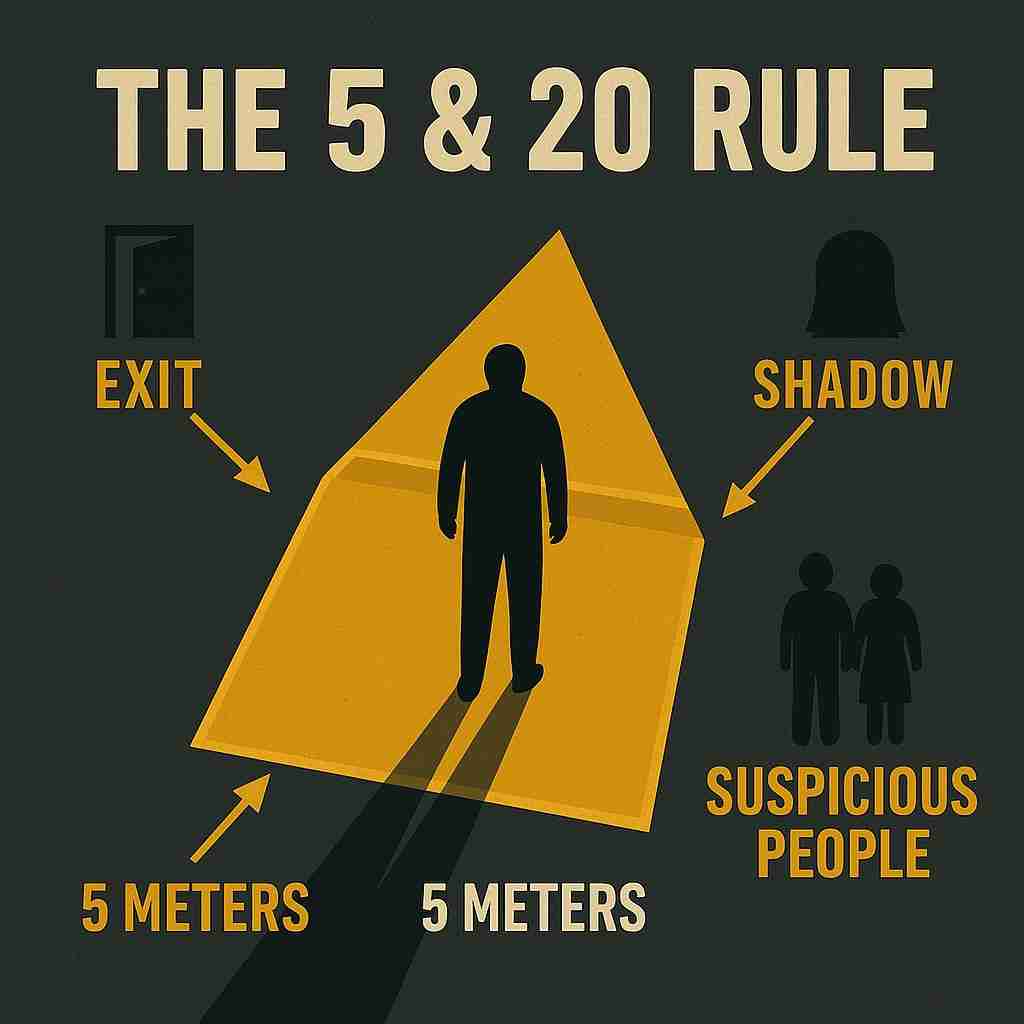
What is the 5 and 20 Rule?
-
5 seconds : When you enter a space (a parking lot, a station, a bar, a side street, etc.), mentally stop and observe it for 5 seconds. Breathe. Look at the exits, the shadows, the people present, the potential threats .
-
20 seconds : Look long range , about 20 meters away from you, to understand what is happening long before you get there. Anticipation is everything. Reaction time is money, or rather: it is life.
A simple yet powerful technique to train your situational awareness . It’s like a portable mental radar, always on.
5 seconds – Observe the present
As soon as you enter a space (parking lot, station, bar, side street…), mentally stop for 5 seconds .
Breathe. Look where you are.
Analyze:
- The exits
- The shadow
- The people present
- The blind spots
- Any inappropriate behavior
These 5 seconds can save you 5 months in the hospital.
20 Seconds – Scan the Future
Observe from about 20 meters away , to understand what is happening before you get there .
- Is there anyone stuck in a strange area?
- Is there a vehicle running with people inside?
- Is anyone walking unnaturally?
- Is there a group moving in a triangle or watching you?
See first = decide first = live better .
Why is it vital?
Because anticipating is surviving .
Reaction time is not a technical detail :
It is the currency of exchange between your freedom and your safety.
Whoever applies this rule, every day, trains his eyes, mind and instinct .
And in the urban jungle, he who sees first… chooses how to get out.
Concrete Example #1: Leaving Work – Parking at Night
You just finished your shift. It’s late. The parking lot is semi-deserted. Your car is 50 meters away. What do you do?
-
Stop for a moment. Breathe and look carefully.
-
Apply the rule of 5: Check the perimeter near you .
-
Then the 20: Look where your car is .
– Is there someone between you and her? Something or someone out of place?
– Are there vehicles running? People sitting in cars? -
If you see something that doesn’t add up , change your route or immediately return to a safe area.
-
If you feel watched or chased, don’t go straight to the car : go around it, create time, check. If you’re being followed, you’re still near a building or an exit. If you’re at the car, you’re alone.
Concrete example #2: Walking on a crowded street – Radar activation
When you walk down the street, most people only look at:
- the cell phone
- your own feet
- or the people immediately in front
Fatal error. You have to look beyond .
Eyes on those who are 10, 15, 20 meters away from you . Even if you don’t see the face, you can observe:
- Type
- Body type
- Clothing
- Behavior (isolated, nervous, too quiet, with hands hidden?)
- Positioning (is he moving closer to the wall to hide? is he staring at you while you are still far away?)
In a group? Isolated? Alone? Is he sending signals to someone you haven’t noticed yet?
This allows you to create risk profiles , and take action:
Change sidewalks, deviate, slow down to let others go ahead, or prepare yourself psychologically.
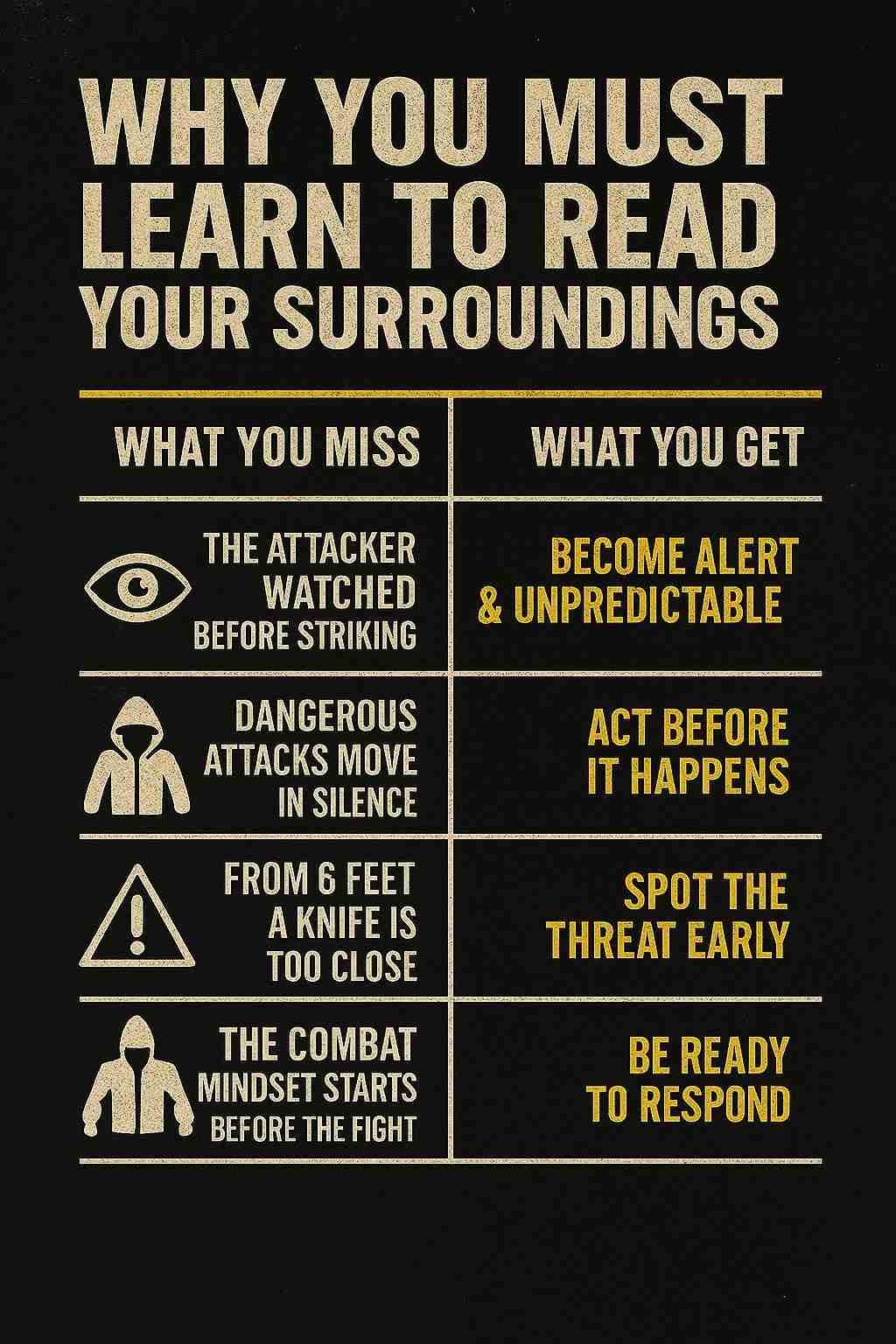
Why it is vital to learn to read the environment
Because the attacker has already observed.
The attacker studies, analyzes, chooses who is not looking, who is distracted, who is predictable .
Because the most dangerous attacks come not from those who scream , but from those who move silently, quickly, decisively, without warning.
Because a knife pulled out two meters away is already inside your living space .
If you only see it at that moment, you are one thought too late .
And most of all, because the fighting mentality doesn’t start with the fight.
It starts before .
It starts when your gaze intercepts the anomaly .
When you realize that something is not right.
When you haven’t had to use your hands yet, but you are already ready to do so .
True self defense doesn’t start with a punch .
It starts with a trained eye and quick thinking .
SYMBOL – Why Learning to Read the Environment Saves Your Life
| Reason | ⚠️ Consequence if you ignore | ✅ Advantage if you apply it |
|---|---|---|
| The attacker observes before striking | You become a predictable target | Make your behavior unpredictable and alert |
| Dangerous attacks come silently, without warning. | You don’t have time to react | You move, slow down, change direction before it happens |
| At two meters a knife is already too close | If you see it there, you’re late. | You notice it before it’s drawn: you avoid, you act, you dodge |
| The fighting mentality starts with the look | React only when it’s too late | Anticipate and decide beforehand whether physical contact is necessary |
| True self defense doesn’t start with a punch | You rely only on physical or technical strength | You save yourself with your mind, with your instinct, with your environmental reading. |
Visual summary:
- Look first
- Predict first
- Act first
- ✋ Avoid conflict
- If needed, you are already ready to strike
Practical Exercise: Train Your Strategic Vision Every Day
Your gaze is a weapon. But only if you train it.
Perception is not a gift: it is a skill . And like any skill, it must be developed day after day , on the field.
Here’s a simple yet powerful exercise to boost your “urban radar” whenever you move around the world.
♂️ 1. When you leave a place, don’t look at your cell phone.
90% of people look down at their screen as soon as they step out of a building.
Deadly mistake.
Look up. Breathe.
Look straight ahead.
Activate your mind before your body.
2. Scan the environment: 5 seconds – 3 details
In each new environment (street, bar, gym, station…), take 5 seconds to identify 3 relevant details.
They can be:
- A person standing in an ambiguous position
- A hidden emergency exit
- A vehicle running with someone inside
- A shadow around a corner
- A blind spot
The goal is to see before your body enters the space.
3. Active walking: profile a person from a distance
While walking, choose a person about 15-20 meters away from you .
Observe without being noticed. Analyze methodically.
Here’s what to read:
- Step → Regular or nervous? Dragging feet? Walking in a line?
- Muscle tension → Shoulders high? Hands tense? Body ready or limp?
- Gaze → Is he actively observing? Is he staring at someone? Is he avoiding faces?
- Hands → Free? In your pocket? Is he holding something? Hidden?
- Social distancing → Does he/she stand too close to others? Does he/she keep his/her distance? Does he/she move in circles?
The more you practice noticing these signals, the sharper your instincts become.
And instinct saves your ass when logic is too slow.
Bonus: Write it all down
At the end of the day, write in 2 lines what you observed , what struck you and what you would have done in case of an anomaly.
This is mental shadowboxing.
No one sees you doing it, but you are building a warrior inside.
Motivational quote:
“He who sees first, wins first.”
In the urban jungle, the predator is not the strongest.
He is the one who sees the prey first … or the deception.
✅ Final Checklist – Rule of 5 & 20
Questions to ask yourself every time you enter a space
Immediate Field of View (5 seconds)
☐ What do I see near me?
☐ Where are the exits?
☐ Are there strange movements, unusual sounds or isolated figures?
☐ Is there anything that “jars” in the context?
Long Range Field of View (20 meters)
☐ What do I see in the long range?
☐ Is someone watching me too closely?
☐ Is someone moving towards me or changing direction unnaturally?
☐ Are there groups strategically occupying the space?
Path Evaluation
☐ Am I walking in a “funnel”?
(dead ends, spaces between cars, blind corners, walls, fences, hedges…)
☐ Do I have an escape route or the possibility of changing course easily?
☐ Is there a way to get back to safety if something goes wrong?
Mental Trigger finale
“Don’t wait to feel the danger.
Look for it, read about it, anticipate it.
And if you don’t find it… great. But at least you were prepared.”

It all starts in a parking lot. And it ends in 12 seconds.
It was 7:45 PM on a Friday. Marta had just finished shopping at the supermarket. The sky was already dark, the parking lot almost deserted. The streetlights made yellowish reflections on the rain-soaked asphalt. She walked with a determined step towards her car, keys already in one hand and her phone in the other, while she checked the notifications.
A few feet away, a gray sedan was parked in reverse, its windows tinted and its engine off. No sound. No visible movement. Yet, inside were two men. Standing. Silent. Waiting.
Marta didn’t see them. Not because she wasn’t paying attention, but because she didn’t really look . She didn’t apply the 5-second rule : stop for a moment, breathe, observe. Nor the 20-meter rule : anticipate with her gaze where she was going, scan the area.
When she got to her car, one of the two men was already outside. No words. Just the acceleration, the push against the side of the car, the hand that searched for the bag. In less than 12 seconds, everything had already happened.
What if he had looked first?
It took 5 seconds to notice that something was wrong .
It took 20 meters to change direction, go back to the entrance, simulate a phone call or ask someone to accompany her.
But Marta was on “autopilot”. And autopilot does not save your life.
This episode is not isolated. It is the exact photograph of what happens every day all over the world , to men and women who think they are safe just because “they are close to home”, “there is light” or “it is a quiet area” .
True safety is not in habits, but in active awareness .
In that look that precedes danger .
In that choice that anticipates the event .
Man alone in an urban context (jacket, underground garage, 9:00 pm)
“No one in the parking lot. Just my reflection in the glass.”
Giulio was returning home after a long day at work. He left his car in the underground garage, the typical muffled silence broken only by the clicking of pipes. He was wearing a blue trench coat and clutching his briefcase. He was concentrating on the lock of the door when he saw it: a figure behind him reflected in the glass.
Too close. Too fast.
He had heard nothing. No voices. Only his distraction.
He had not stopped for a second to observe before going down. He had not looked down the garage. No scan of the 20 meters.
Now, it was too late. The attacker was behind him, and in an instant he was yanking him to steal his wallet and phone.
In 8 seconds.
Over 60 (elderly, bus stop, early evening time)
“I thought he was just a kid. I was wrong.”
Carlo, 67, was at the bus stop at 6:30 p.m. He was coming back from the pharmacy, the bag of medicines in his left hand. The sky was still bright, and there were three boys on the other side of the street. They were laughing loudly, one was kicking a sign.
They didn’t look dangerous. Just exuberant. He didn’t look at them too much. He didn’t change position. He didn’t pay attention to the distance.
When one of the three crossed the street and approached him suddenly, Carlo didn’t have time to understand. In an instant, he was pushed against the shelter. The briefcase disappeared.
“I didn’t see where it was coming from ,” he later told police. But the truth is, he hadn’t looked hard enough beforehand .
DAILY DRILL – The 5:20 Radar
Drill Goal
Train your situational awareness every day until it becomes an automatic reflex , like the uppercut in combat.
Daily instructions
Every day, choose a new environment where you are for at least a few minutes. Ideal examples:
- A bar or a club
- The train or metro station
- The parking lot of a supermarket or gym
- A bus stop
- A crowded pedestrian area
️♂️ Apply the 5 and 20 Rule
-
As soon as you enter the space, stop for 5 seconds.
-
- Breathe. Look at your near field of vision.
- Noticed exits? Obstacles? People staring at you? Strange noises?
-
Observe at 20 meters.
-
- Who’s on your path?
- Is someone moving towards you?
- Do you see someone isolated in an abnormal position?
-
Take a mental note.
-
- Have you noticed something that doesn’t add up?
- Would you have changed your path?
- How would you have acted if something had happened?
✍️ Extra Task – Radar Log
At the end of the day (or in the moment, if you can), write down 3 things you noticed :
- 1 visual detail
- 1 suspicious or attention-worthy person
- 1 possible escape route or mistake you could have made
Do this for 7 days.
At the end of the week, reread everything.
You will find that your eye has become quicker, more precise and colder.
Bonus Motivation
“It’s not about seeing everything. It’s about seeing first .”
Your mental radar doesn’t build itself. You train it every day, like punching an invisible punching bag. It’s mental shadowboxing , and it works.
Weekly Diary – 5 and 20 Rule
Mental training for situational awareness
Day 1
Chosen environment:
☐ Bar / Cafe
☐ Parking
☐ Station / Metro
☐ Bus stop
☐ Supermarket
☐ Other: _____________________
What I noticed in the first 5 seconds:
What I observed in the 20 meters in front of me:
What I could have done differently:
Copy and paste the section above for each day of the week (Day 2 → Day 7).
️ Recommended environments to alternate in the 7 days
✅ Supermarket (parking lot or inside)
✅ Public transport (bus, tram, metro)
✅ Entrance to a shopping centre
✅ Gym or office parking lot
✅ Busy sidewalk
✅ Nightclub / bar
✅ Alley or less lit area
✅ Elevator / underground garage
✅ Isolated evening stop
Tip: Change the scenery every day to develop visual adaptation.
Weekly Self-Assessment Grid
| REQUEST | ✅ YES | ❌ NO | NOTE |
|---|---|---|---|
| Have I applied the 5 seconds every day? | |||
| Did I scan the 20 meters at least once a day? | |||
| Did I notice anything suspicious that I might have missed before? | |||
| Did I write notes by the end of the day? | |||
| Have I changed my behavior based on what I observed? | |||
| Do I feel more present and aware in public places? | |||
| Have I talked to anyone about this drill? |
Conclusion of the week
-
What did I learn about myself?
-
In which environment do I feel least attentive?
-
What can I improve?
THE 7 DAY CHALLENGE – 5 & 20 RULE CHALLENGE
Do you dare to look first?
For the next 7 days , I’m challenging you to a challenge that can really change the way you move through the world.
Every time you enter a new environment — be it a bar, a gym, a parking lot, a station, a supermarket — apply the 5:20 rule :
✅ Stop for 5 seconds and observe the immediate environment.
✅ Scan 20 meters in front of you to detect movements, suspicious people, obstacles, escape routes.
It’s not a game. It’s pure mental training. It’s building that invisible radar that can make the difference when it counts.
How to participate:
-
Do this for 7 days. Different environment each day.
-
Write down 3 things : what you saw immediately, what you scanned, and what you could have done in case of danger.
-
Share your experience in the comments or on social media using the hashtag:
#SteelMindSet5e20
You can also send me a private message or an email. If you want, I will publish the testimonials (anonymously) to help others learn from you.
Why do it?
Because awareness is a muscle .
And if you don’t train it… it atrophies.
He who trains the body defends himself.
He who trains the mind avoids having to do it.
Invisible reward: more clarity, less fear.
I promise you one thing:
After these 7 days, you will never look at an environment the same way again.
You will see sooner.
You will understand better.
And you will move like a predator, not prey .
The 5 and 20 Rule for Women’s Defense
If you are a woman and have ever found yourself feeling uncomfortable in a semi-deserted parking lot, on an almost empty subway car, or while walking home alone in the evening , then this rule can become your best invisible ally.
You don’t have to become a martial arts expert to avoid dangers.
You have to look first.
You have to stop for those 5 seconds at the exit of the supermarket , when you are still under the lights, and check your surroundings.
You have to observe who is 20 meters away , who is walking behind you, who is stopped near your car, who is looking at you too much.
Your strength is not in your muscles, but in your timing.
And timing comes from awareness.
This rule gives you power. It gets you out of “I hope everything goes well” mode and into “I’m managing my safety” mode .
And trust me: it shows, it feels. And often it’s enough to dissuade.
The 5 and 20 rule for over 50s
Once you’re over 50, it’s not just about “fighting” or “physically defending yourself.”
The real weapon becomes active prevention.
Reflexes are slower, the alarm threshold is less acute, and attackers know it.
But what you can develop — and what no one can take away from you — is the ability to read the environment before you even enter it .
When you arrive in a parking lot, in a pharmacy, in a less lit area:
-
Stop for 5 seconds. Look around, analyze the faces.
-
Scan 20 meters. Who is there? Is there a car with people inside? Is there someone too close to the exit?
-
If you notice something strange, go back, change your route, ask someone to accompany you.
Freedom is not doing what you want.
It is knowing when not to do it.
With this rule, even those who no longer have the energy of a twenty-year-old can become difficult to surprise.
❌ The Most Common Mistakes – And Why They Make You Vulnerable
You don’t need weapons, secret techniques or super powers to put yourself in danger.
Routine is enough. A few wrong automatisms
repeated every day are enough . Here are the most frequent — and dangerous:
Looking at your smartphone while walking
You’re looking at Instagram. He’s looking at you.
Who wins?
Thinking “It won’t happen to me anyway”
False sense of security = alarm off = easy target.
The illusion of a quiet zone disarms you more than a surprise attack.
Entering an environment without scanning
You open the door, go in and jump in. You didn’t see the exits, nor who was inside.
If something happens… you’re trapped.
Go straight to the car without checking the surroundings
Parking is a red zone.
Whoever is waiting for you already knows where you are going.
If you don’t check first, you are predictable.
And whoever is predictable… is attackable.
♂️ Confusing awareness with paranoia
Being present doesn’t mean being afraid.
It means being ready, clear-headed, one step ahead .
Paranoia paralyzes. Awareness protects you.
Dismantle the excuses. Re-energize the radar.
All these mistakes have one thing in common: they arise from distraction and illusion.
The rule of 5 and 20 does not ask you to live in panic.
It asks you to consciously choose where you put your eyes.
Because those who see better, live better. And longer.
Mental Trigger – The Last Choice is Yours
There is no need to become paranoid.
You need to become prepared .
You need to turn on the radar before entering a gray area.
You need to walk like someone who has already decided not to become a victim .
If you see first, you live better .
If you anticipate, you are never late .
The world won’t adapt to you.
Dangers won’t warn you.
Reality doesn’t have a “pause” button to make you think.
You have two options every day:
Live automatically, expecting everything to be fine.
Or live consciously, trained in reality , ready to see what others ignore.
Choose which side of the story you’re on:
Spectator… or survivor.
Conclusions – Street Fight Mentality: He who looks first, wins first.
In the real world there is no room for naivety. The street does not forgive those who walk with their heads down, distracted, with their cell phone in their hand and their mind elsewhere.
The truth is simple and brutal:
if you don’t see the danger, you are a statistic.
The 5/20 rule is not just a technique. It’s a mindset.
It’s the ability to read the scene like a predator, not like prey .
It’s the difference between “walking” and “moving with awareness.”
It’s what allows you to anticipate an attack … before it even exists.
Every step you take in the urban jungle is a decision.
You can choose to stay blind, hoping nothing happens.
Or you can turn on the radar , observe, reason, deviate, act.
Street Fight Mentality is not paranoia .
It is discipline.
It is clarity.
It is survival.
Train your gaze.
Train to read the signs.
Train to move with the intention of coming home every night.
And remember:
“He who looks first, wins first. He who reacts late… has no reaction.”
FAQ – Situational Awareness & The 5/20 Rule
1. What exactly is the 5 and 20 rule in self defense?
It is a mental technique to increase situational awareness. In practice:
-
5 seconds to observe the immediate environment when entering a space (parking lot, street, premises, etc.)
-
20 seconds to look away and assess any threats or anomalies on the path to your destination.
2. Is this a technique also used by security professionals?
Yes. It is used by law enforcement officers, military personnel, bodyguards, martial arts instructors, and private security personnel. It is part of the so-called “Combat Mindset” and mental preparation for risky situations.
3. Is it useful even if I don’t practice combat sports or martial arts?
Absolutely. Situational awareness is independent of your physical preparation . Even someone who has never made a hit in his life can avoid an attack simply by reading the scenario in advance.
4. Is it useful during the day too, or only at night?
It works at all hours . At night the risk increases, but even during the day you could find yourself in ambiguous situations: isolated streets, stations, garages, underpasses, suspicious gatherings. The 5 and 20 rule must always be applied , until it becomes automatic.
5. How can I train my visual awareness?
Here are 3 simple daily exercises:
-
When entering a place, identify 3 unusual items in less than 5 seconds.
-
Always look at who is 15-20 meters in front of you when walking.
-
When you are standing in line (e.g. in a queue), try to notice who is watching you or coming too close .
6. I’m afraid of appearing paranoid. Is this normal?
Yes, and it is a common initial step. But you will soon realize that you are not becoming paranoid, you are becoming lucid . Awareness is not living in fear, but living in control . The predator is not anxious; he is present.
7. And if I notice something suspicious, what should I do?
It depends on the context, but never ignore it . The options are:
-
Change route.
-
Return to a safe area.
-
Call for help or fake a call.
-
Keep your distance and observe.
-
If necessary, be mentally prepared to defend yourself .
8. Can I teach it to my children or loved ones?
Yes, and you should. Just adapt your language. Even a teenager can understand the difference between walking “dreaming” and walking “looking”. It is a survival gift that you can pass on without creating fear, but with awareness.
9. Does this rule also apply to closed environments?
Sure. You walk into a bar? Do your 5 seconds of scanning: who’s there, who’s looking at you, where are the exits. You’re getting into an elevator? Who’s in there? What’s their posture? Do they have something in their hand? Always 5 and 20. In and out. Always.
Auto Amazon Links: No products found.


